000100.KS is the global ticker format we use for Yuhan on platforms like Yahoo Finance and TradingView, where ".KS" signals a KOSPI-listed stock.
Verdict: NEUTRAL. We'd turn more positive if earnings visibility improves and the valuation cools to match that progress. We'd turn cautious fast if price breaks key trend support while expectations stay sky-high.
At the latest close we're using, Yuhan trades around ₩94,700, which is about $64.63 at $1 = ₩1,465. That dual-currency view matters because a great KRW chart can still look choppy in USD terms when the exchange rate moves.
For K-stock newbies, we'll keep this simple: (1) what Yuhan does, (2) what the market seems to be pricing in (valuation and chart cues), and (3) the main risks plus a basic hedge idea if we're wrong.
 Yuhan's long history in Korea, shown as a classic headquarters scene, created with AI.
What Yuhan does and where it sits in Korea's healthcare value chain
Yuhan is one of Korea's long-running healthcare names, founded in 1926 and headquartered in Seoul. It's an individual stock, not an ETF, so our results depend on this one company's execution and market mood.
At a high level, Yuhan makes and sells a mix of:
- Prescription drugs
- Over-the-counter (OTC) medicines
- Veterinary drugs
- Household goods
- Animal feed
- Health functional foods
That mix matters. Prescription drugs usually carry the "story" because new therapies and licensing deals can change growth expectations quickly. OTC can be steadier because consumers repeat-buy trusted brands, and distribution reach tends to compound over time. The non-pharma lines can act like ballast in rough seas, but they can also mute the excitement that investors want from a "pure" drug developer.
Positioning in the value chain is the real lens we use. Yuhan touches multiple links: R&D and drug commercialization (where upside can be large but uncertain), manufacturing and supply (where quality systems and scale matter), and distribution plus brand trust in OTC (where shelf space and reputation can support pricing power). When that chain works well, Yuhan doesn't rely on only one channel to keep cash moving.
For context on how management frames its global ambitions around its centennial milestone, see this recent coverage from Korea's business press on Yuhan's 100th anniversary push toward global new drugs: MK's report on Yuhan's centennial strategy.
Business mix in one view: pharma, OTC, and the non-pharma lines that can smooth results
Non-pharma segments can help stabilize cash flow because people still buy household items and animal-related products even when drug cycles wobble. On the other hand, those segments can dilute the "high-growth biotech" narrative, which often drives sharp reratings in Korea.
What we watch is straightforward:
- Product launches that show Yuhan can refresh the portfolio, not just harvest legacy brands.
- Licensing or co-development deals that shift a pipeline from "hope" to "priced-in progress."
- Pharma growth versus the rest, because the market usually rewards the segment with the biggest optionality.
What drives demand in Korea, and why global investors should care
Korea's demand drivers look familiar: an aging population, chronic disease treatment, strong hospital channels, and consumer interest in health products. Still, the trading behavior can feel different if you're used to US large caps.
Sentiment can flip fast because retail participation is high and "theme" moves can pull money in and out quickly. Even stable healthcare companies can swing when the market rotates toward AI hardware, shipbuilding, batteries, or dividends. That doesn't make Yuhan "speculative," it just means we respect the tape.
Our quick investment read on Yuhan (000100): price, valuation, and the Korea-style technical picture
We anchor on ₩94,700 (about $64.63) for this read, while noting that quotes can vary by source and timestamp. Yuhan's market cap is about $5.01B, or roughly ₩7.3T using ₩1,465 per dollar (approximate conversion).
The headline issue is valuation. Screened metrics show:
- P/E around 118.6x versus a healthcare sector reference near 11.2x
- P/B around 3.8x
- P/S around 3.7x
A P/E this high usually means one of two things. Either the market expects major earnings growth ahead, or current earnings are temporarily low (so the denominator is small). In both cases, the stock can trade like a tightrope walk. Execution must stay clean, because the market already paid up.
If you want a quick place to confirm live pricing, corporate actions, and basic ratios in one screen, we use Yahoo Finance's 000100.KS quote page.
When valuation is stretched, the chart becomes less forgiving. Bad news hits harder, and good news needs to be better than expected.
Recent volatility gives us a reality check. In July 2025, one day saw an outsized move (around +20%) and an intraday swing near 19%, a reminder that "defensive healthcare" can still jump around in Korea. We also treat the ₩98,175 to ₩133,086 3-month range estimate (90% probability in a horizontal trend) as a volatility frame, not a promise.
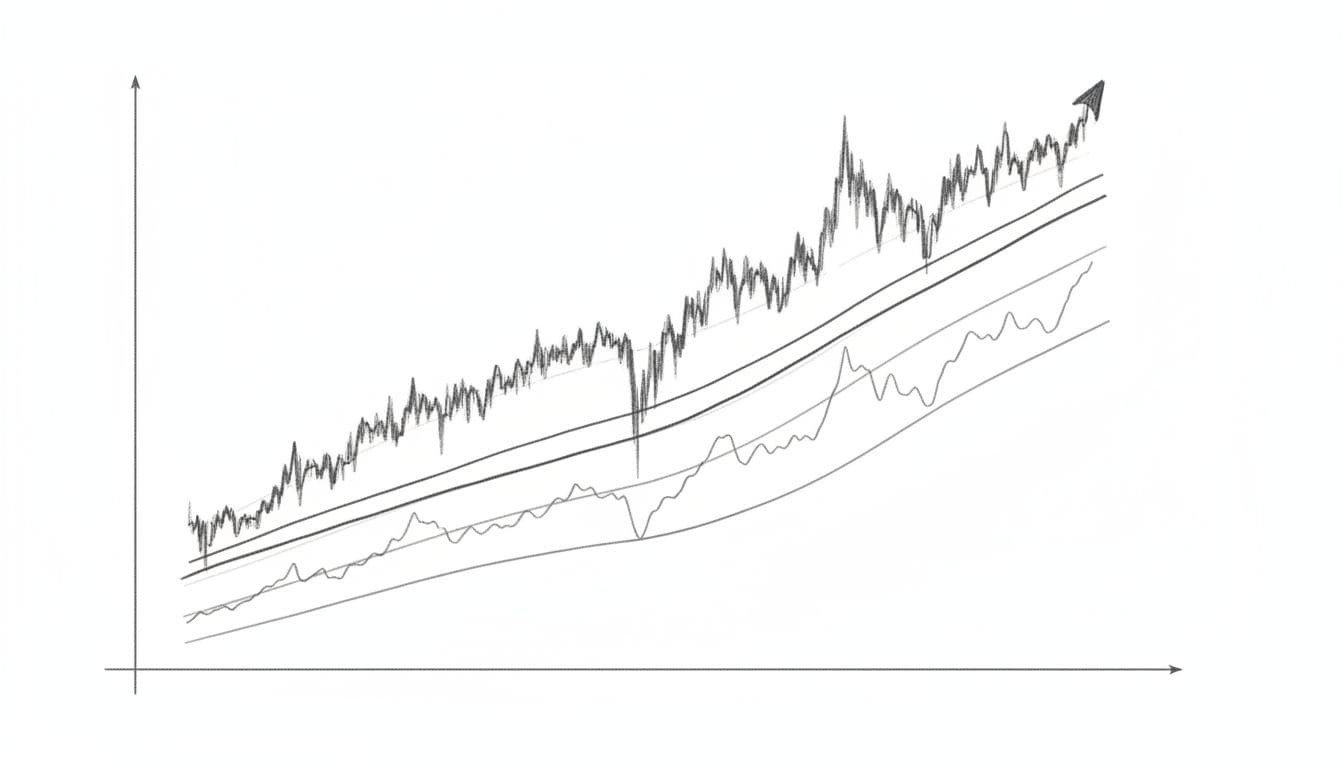 A simplified moving-average crossover concept, created with AI.
The simple chart checklist we use (and the 120-day "Half-year Life Line" in Korea)
Korean traders often treat the 120-day moving average as the "Half-year Life Line." It's a practical line in the sand, many participants watch it, so price reactions can become self-fulfilling.
We'll fill the exact values from a charting source at publish time (our data pull didn't include the MA numbers), but this is the structure we use:
| Metric | Value (fill from chart) | How we read it |
|---|---|---|
| 5-day MA | TBD | Short-term momentum and reaction speed |
| 20-day MA | TBD | The "working trend" for many swing traders |
| 120-day MA (Half-year Life Line) | TBD | Medium-term health of the trend |
| Price vs. 120-day | TBD | Above tends to support dips, below raises risk |
| Trend note | TBD | Crossovers help us avoid emotional entries |
Our rule is simple: we don't chase if price is extended above the 5-day and 20-day lines. Instead, we prefer pullbacks that respect the 120-day line, because that's where risk often becomes easier to define.
Investor psychology: where retail profit-taking often shows up, and how we plan entries
Korea's market has a strong retail presence, so price can behave a bit like a crowded subway platform. When the doors open, people move together.
Profit-taking often shows up after sharp rebounds, especially following a 10% to 20% move in a short window. Traders also tend to react around round numbers (like ₩100,000) and around prior swing points that many can see on the chart.
We avoid fake precision here. Instead, our entry plan usually looks like this: wait for a pullback, check whether volume calms down, then see if price holds a widely watched trend line (often that 120-day). If the stock slices through support on heavy volume, we step back and reassess. We'll confirm the actual levels on the live chart at publish time, rather than anchoring to stale reference points.
For one example of how the market narrative can shift based on a key therapy, see Businesskorea's report on record performance tied to Leclaza.
Investor Alert: the risks that can break the bull case, plus a simple hedge if Yuhan drops
The first risk is valuation risk. With a very high P/E, the market has little patience. Even "good" results can lead to selling if guidance doesn't raise the ceiling.
Next comes earnings disappointment risk. High expectations leave less room for timing issues, pricing pressure, or one-off costs. If earnings stay soft while the stock stays expensive, rerating risk grows.
Volatility is another risk we can't ignore. Past large daily swings show that liquidity and sentiment can amplify moves. On top of that, Korea's theme rotation can pull money away from healthcare quickly, even if nothing changed inside Yuhan.
We also keep a discipline checklist for governance and overhang items, including insider selling, major shareholder changes, capital raises, and litigation. We're not alleging any of these here, we're saying we check.
For material updates, we verify filings directly in Korea's DART disclosure system.
If Yuhan breaks down, our simple hedge is to reduce single-name risk. We can pair it with a more defensive, lower-volatility Korea healthcare name (confirmed separately), add broad Korea index exposure, or keep more cash. When healthcare cools, we also consider rotating part of the risk into high-quality dividend large caps, which often hold up better when narratives fade.
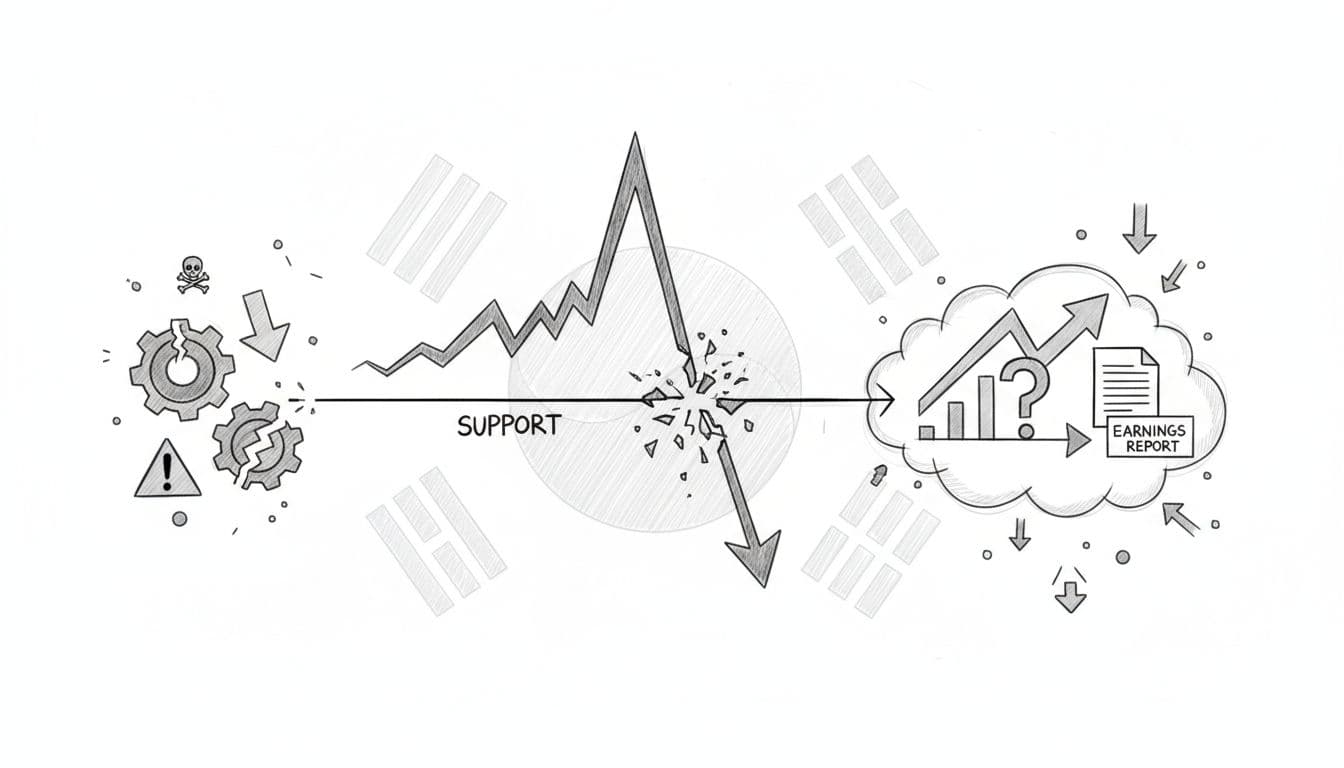 A visual summary of common risks we monitor, created with AI.
Conclusion
We stay NEUTRAL on Yuhan (000100.KS) at around ₩94,700 (about $64.63) because the valuation already prices in a lot of success. Our "if this, then that" checklist is clear: we get more constructive if the trend holds above the 120-day Half-year Life Line, earnings visibility improves, and valuation normalizes without a major price drop. On the other hand, a breakdown with volume, a worsening earnings outlook, or a negative surprise in DART would weaken the case quickly.
K-stocks can move fast, even for established healthcare names. Next step: set price alerts, review DART filings, and size positions so one rough day doesn't wreck the account.
https://www.seoulstockalpha.com/
Related: LIG Nex1 (079550.KS) Stock Snapshot for Beginners: Theme, Technicals, and Risks (March 2026), NAVER Stock (035420.KS) and the End of AI "Issue Timeline": What It Means for News, Trust, and Investors (March 2026), Amorepacific Corporation (090430.KS): A Beginner-Friendly Stock Guide (March 2026).
Originally published on SeoulStockAlpha.