When you hear "the most profitable stock," you probably picture chips, cloud software, or Nvidia. So it feels almost wrong that a Korean ramen company keeps showing tech-like profitability.

Samyang Foods, the company behind Buldak "fire noodles," has become a rare case in K-Food: fast growth, high margins, and a brand that keeps selling even when people complain it's too spicy. If you're a Korean stock newbie, this story is easier than it looks, because it's not complicated tech. It's supply, demand, and pricing power.

https://www.youtube.com/watch?v=Dqok6nojjeE
Executive Summary (Rating First): BUY for long-term growth, watch entry price
Rating: BUY (for a beginner-friendly, long-term watchlist), mainly because the business shows unusually strong profitability for packaged food and still has capacity growth ahead. The big catch is valuation swings, since K-theme stocks can move like momentum trades.
Before you go further, one quick ticker note for global charting platforms: Samyang Foods (003230.KS) is the 6-digit Korea code, and ".KS" is the Yahoo Finance and TradingView format for KOSPI listings. In the US, you may also see Samyang Foods (SAMYF) on the OTC market, which can have wider spreads and lower volume.
Here's what you can anchor on for price context, using the latest public quotes found in the data pulled for this post (no verified March 2026 live quote was available in those results):
| Reference point (from sources) | Price (KRW) | Approx. USD (KRW 1,375 per $1) | What it tells you |
|---|---|---|---|
| Reported close (June 9, 2025) | ₩1,140,000 | ~$830 | A "baseline" level after a big run |
| Reported quote (Dec 24, 2025) | ₩1,265,000 | ~$920 | Shows how quickly price can re-rate |
The "most profitable K-Food stock in history" label depends on what you measure (margin, ROE, multi-year compounding, or peak valuation). Still, Samyang's recent numbers are strong enough that the question isn't crazy.
If you want one simple takeaway: you're not buying noodles, you're buying global distribution plus pricing power.
Why Samyang Foods looks "too profitable" for a food company
Packaged food usually wins by selling a lot at modest margins. Samyang has been doing something else: selling a lot at very high margins, helped by export mix and a premium product line that people treat like a challenge, a gift, or a collectible.
Based on the realtime data available for this article, Samyang's recent profitability profile has stood out:
- Net profit margin around 16% (using net income versus revenue from the provided figures).
- ROE around 42%, which is unusually high for a consumer staples-style business.
- Operating margins above 20% in recent quarterly reporting cited in the pulled data.
If you're new to Korean stocks, think of this like a restaurant with a line out the door. It raises prices a little, expands seating, and the line still doesn't go away. That's the best kind of problem.
To sanity-check growth, it helps to look at reported top-line trend sources that track revenue over time, such as Samyang Foods revenue history. You're looking for a pattern where sales rise, but margins don't collapse. That combination is the whole game.

What makes those profits feel more "real" is the export split mentioned in the realtime data: overseas sales were cited as roughly 81% of total in a strong quarter. Exports can boost margins because you often get better pricing, better product mix, and more brand heat abroad.
The Buldak export flywheel: demand first, capacity second
A lot of K-theme winners burn bright and fade fast. Samyang's edge is that Buldak isn't just trending, it's also a repeat-buy item. People try it for the meme, then they keep a box at home.
In the pulled data, Samyang posted very strong year-over-year growth in a recent quarter (sales up 44% and operating profit up 50%), and the US and China were highlighted as major contributors. That matters because your long-term bull case depends on whether demand is global, not only Korean.
A helpful cross-check on how the business has been compounding is the kind of multi-year view you can find on Samyang Foods earnings and revenue performance, which summarizes earnings growth rates and profitability trends. You don't need to treat any single site as "truth." You use it like a second opinion.
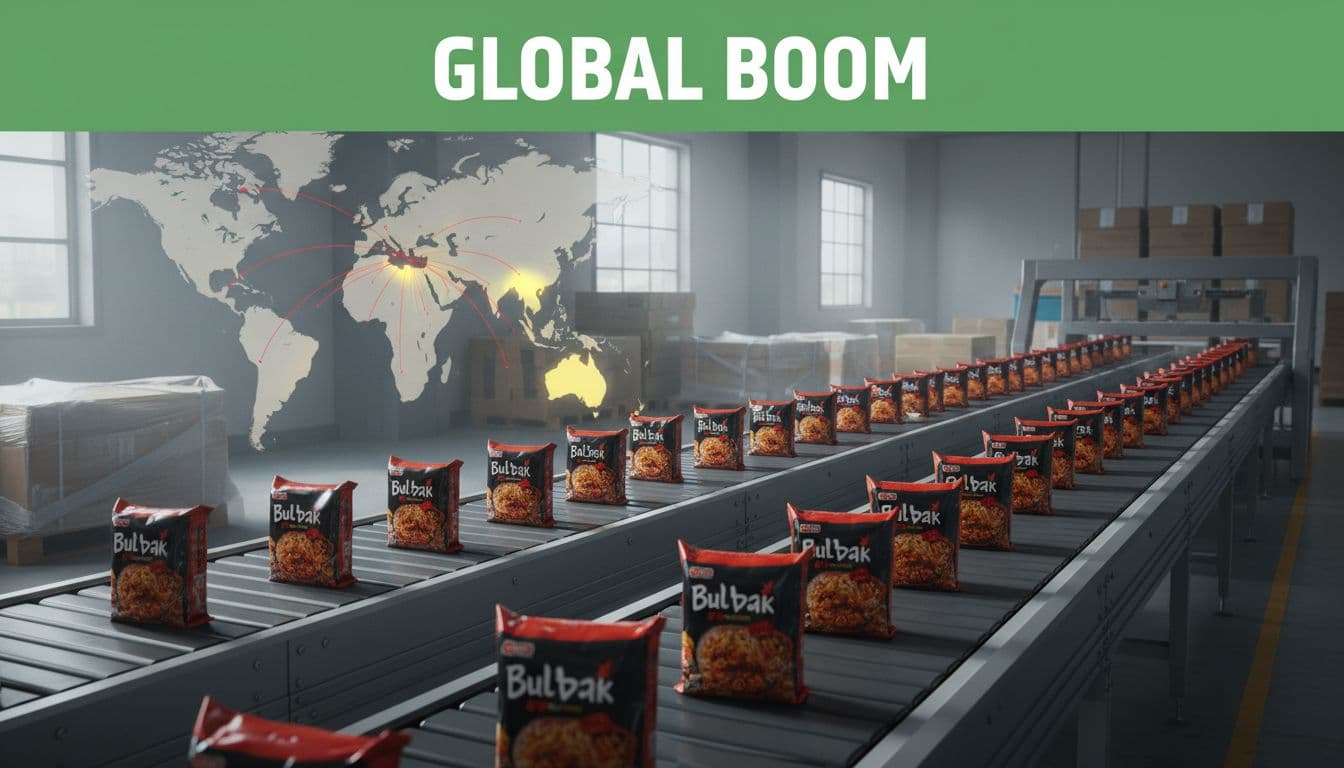
Capacity is the other half of the flywheel. When a brand goes viral, the risk is that you can't ship enough product, so shelves go empty and customers move on. The realtime data referenced new production capacity coming online (including a Korea plant expansion and plans for China capacity). For you as an investor, that's not just "growth." It's a way to defend the brand, because availability keeps the habit alive.
One warning, though: K-food hype can push the stock faster than earnings can keep up. When the narrative is hot, you'll see sharp spikes and fast pullbacks. That's normal in Korea, where retail flows can dominate the short run.
Value chain positioning (and why margins can stay high)
Samyang's position in the value chain is simple, and that's part of the appeal for a beginner. It sits downstream of raw ingredients and upstream of retailers. The company wins if it can do three things better than rivals:
- secure stable input costs, 2) run efficient factories, 3) keep brand pricing power at the shelf.
Here's the mental model: if the brand is the "engine," the factories are the "transmission." You need both, because viral demand without production becomes frustration, while production without demand becomes discounting.
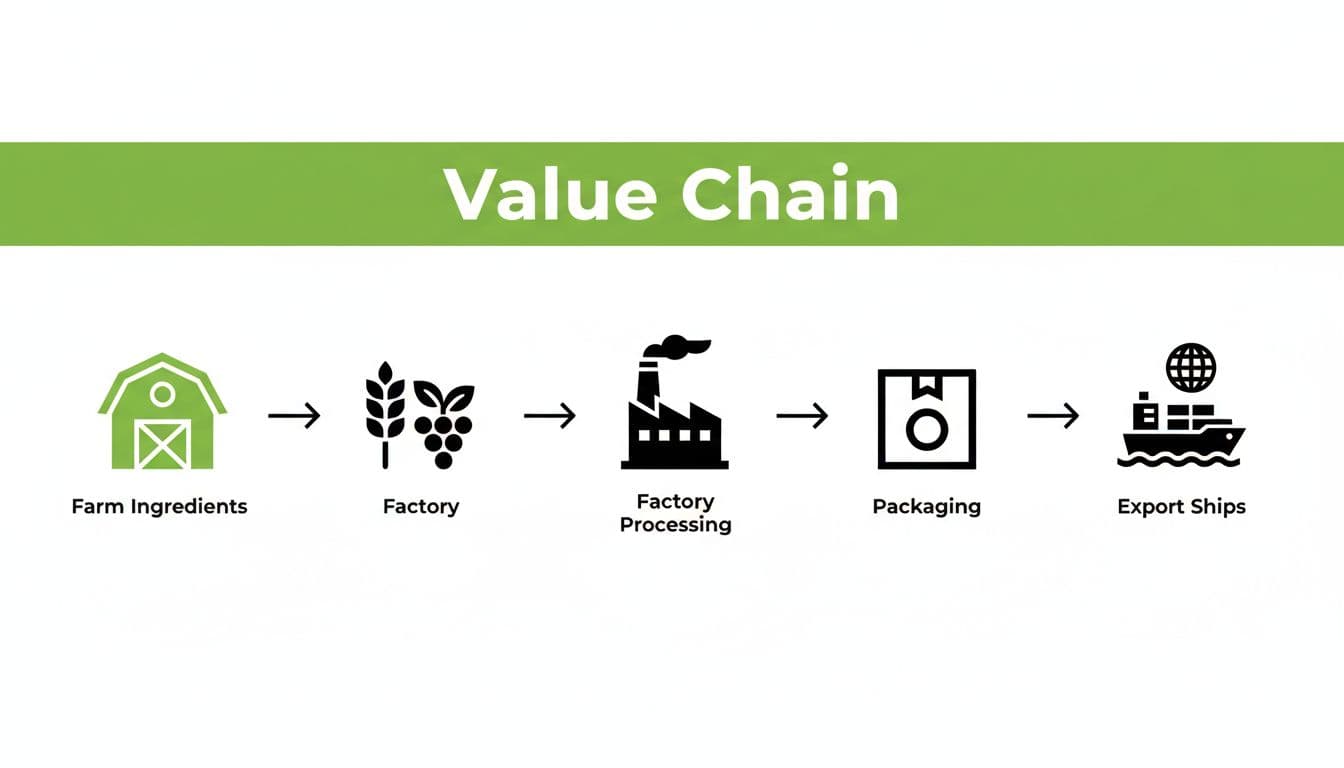
For margin context, you can compare Samyang's operating profitability trend with third-party summaries like Samyang Foods operating margin tracking. Again, you're not hunting for perfection. You're checking whether high margins are a one-off spike or something that holds across periods.
Now add the Korea-specific piece: governance and overhang. Even a great business can face stock pressure if insiders sell, if a large shareholder stake hangs over the market, or if liquidity is thin. You should also watch for secondary offerings, changes in major shareholders, and any sudden rise in pledged shares (if disclosed). Those events don't always change the business, but they can hit the stock hard.
If you want a balance sheet snapshot angle, Samyang Foods equity estimates can help you track whether the company is building capital as profits rise, which often supports long-term compounding.
Investor Alert: Risks to Consider (plus "life line" levels and a hedge idea)
Samyang can be an amazing business and still be a stressful stock. Here are the risks you should treat as real, not theoretical:
K-theme reversal risk: When "K-Food" is the story, momentum money piles in. If the theme cools, the multiple can compress even if earnings stay fine.
Capacity timing risk: Expanding factories is good, but ramp-ups can bring hiccups. If supply jumps faster than demand, discounting can creep in.
FX and overseas exposure: A strong KRW can reduce export competitiveness. A weak KRW can boost reported results, but it can also raise some input costs.
Regulatory and product issues: Spicy products bring occasional headlines. Any major quality issue would be a reputation hit.
Valuation risk: The realtime data referenced analyst-style views that the stock could be "cheap" on a forward earnings multiple, but that can change quickly if expectations get too high. To ground your thinking, it helps to browse a standardized statement view like Samyang Foods income statement pages, then ask one question: are profits growing because of real demand, or because of temporary pricing and mix?
Now, the Korea trading concept you'll hear often is the "life line" (생명선). Many Korean traders call a key moving average (often the 60-day line) the life line because strong stocks tend to bounce there during uptrends. If the stock breaks that line and can't reclaim it, sentiment often flips from "buy the dip" to "sell the rip." You don't need to be a chart expert. You just need one rule: don't ignore trend breaks after parabolic runs.
Retail investor psychology also matters. In Korea, round-number price levels can act like magnets for profit-taking. For Samyang, you should expect selling pressure near milestone levels such as ₩1,000,000, ₩1,200,000, and any widely talked-about target like ₩2,000,000 (mentioned in the pulled data as a target price level from analysts). Traders love neat numbers because they make decisions feel "clean," even when the math isn't.
Finally, consider a simple hedge plan in case this stock falls with the theme. Since Samyang is a consumer export story with momentum traits, one practical hedge is to pair it with a Korea sector that tends to rebound on different drivers, such as large-cap semiconductors (global cycle, AI servers, memory pricing). The goal is not to "cancel risk." It's to avoid having your whole Korea exposure tied to one hot narrative.
One more clarity point for beginners: Samyang Foods is an individual stock, not an ETF. If you prefer diversified exposure, you'd use a Korea consumer or Korea broad-market ETF instead, but that's a different product with different behavior.
Conclusion: Is Samyang Foods the most profitable K-Food stock ever?
You can't crown a single "most profitable" K-Food stock without picking a definition. Still, Samyang Foods (003230.KS) has a rare mix: high margins, high ROE, and real global demand backed by capacity expansion. If you buy it, you're betting that Buldak is more than a trend, and that the company can scale without giving back pricing power. Keep your eyes on the life line, respect round-number selling, and treat valuation spikes as part of the package. Above all, make your plan before the chart gets emotional, because great businesses can still be wild stocks.
https://www.seoulstockalpha.com/
Related: NAVER Stock (035420.KS) and the End of AI "Issue Timeline": What It Means for News, Trust, and Investors (March 2026), Yuhan (000100.KS) Stock Snapshot: What We Think in March 2026, Doosan Enerbility (034020) in 2026: Nuclear Know-How, SMRs, and What Moves the Stock.
Originally published on SeoulStockAlpha.