Oracle (ORCL) just posted an earnings surprise in March 2026, and that's why Korean broker notes are suddenly using phrases like "밸류에이션 상승 기대." An earnings surprise means the company reported profit above what Wall Street expected. A valuation re-rate means investors decide the stock deserves a higher price for the same $1 of earnings, usually because future growth feels safer.
We're going to keep this beginner-friendly. We'll cover what Oracle reported, why the market cares (cloud and AI demand), what could break the story, and a simple price map using moving averages. Also, we'll show prices in both USD and KRW because many of us track both.
Executive Summary (Our Verdict: NEUTRAL)
We're NEUTRAL on Oracle after the beat because the story is strong, but expectations just got heavier. The upside depends on follow-through in guidance and cloud capacity expansion, not just one quarter.
One quick ticker note for new investors: Oracle is a US stock, so it trades as Oracle (ORCL) (not a 6-digit Korea ticker). For Korean stocks on global chart sites, we usually use formats like Samsung Electronics (005930.KS) or an individual KOSDAQ name (123456.KQ). The ".KS/.KQ" suffix is what Yahoo Finance and TradingView use for Korea listings.
Our verdict first: NEUTRAL on ORCL after the beat, because expectations are now higher
A beat can lift valuation, but only if the next few quarters keep proving the growth story. After this report, the market will ask Oracle to "show us again," not "tell us once."
Our rating stays NEUTRAL. We like the direction, but we respect what happens after a big surprise: the bar rises.
Reasons we lean positive:
- Cloud growth is real: Cloud revenue jumped hard, which matters more than old license narratives.
- AI-driven demand is pulling spend forward: AI training and data workloads need databases and cloud capacity.
- RPO backlog supports visibility: Big contracted commitments can reduce fear of a sudden demand cliff.
Reasons we stay cautious:
- Capacity limits can cap revenue: If Oracle can't build fast enough, growth can stall even with demand.
- Competition is relentless: Hyperscalers and enterprise software peers don't give away share.
- Valuation risk increases after a beat: If the stock price moves faster than fundamentals, re-rates can reverse.
Dual-currency snapshot (March 2026): ORCL has traded around $159 to $165, which is about ₩233,400 to ₩242,200 using roughly ₩1,468 per $1. Prices and FX move daily, so we should always confirm on our broker app before acting.
What Oracle actually reported, the key numbers behind the "earnings surprise"
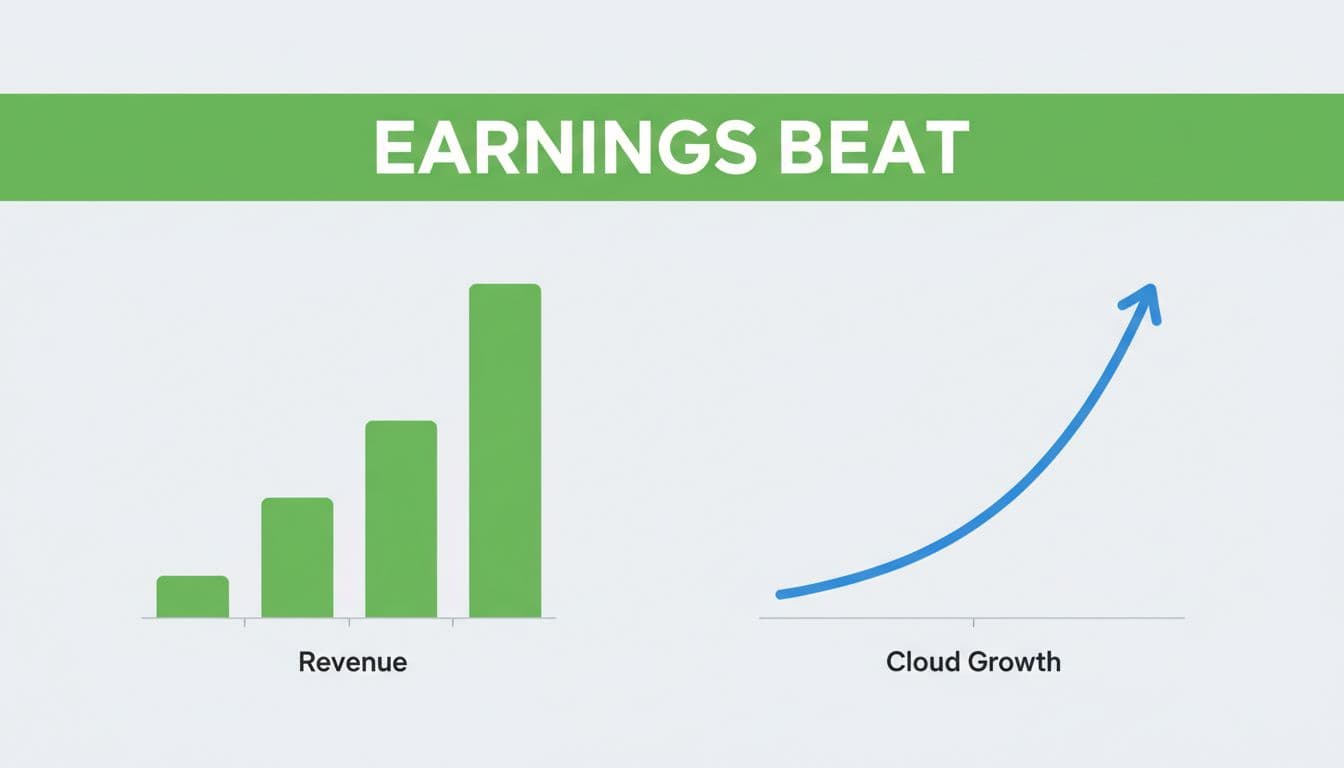
Oracle's fiscal Q3 2026 results (reported March 2026) were strong across the board. For beginners, "across the board" is the key phrase. A one-line EPS beat is nice, but a broad beat changes sentiment.
Here are the headline numbers we care about:
- Total revenue: $17.2B, up 22% year over year. This signals demand strength, not cost tricks.
- Cloud revenue: $8.9B, up 44% year over year. This is the center of the story.
- EPS: GAAP $1.27, non-GAAP $1.79. The non-GAAP number beat expectations around $1.70.
Many headlines quote non-GAAP EPS because it tries to show "core operating" earnings by adjusting certain costs. We don't need to pick sides. We just need consistency: if the market prices on non-GAAP, we track it too, while still respecting GAAP as the official accounting view.
The most eye-catching datapoint was RPO (Remaining Performance Obligations) at $553B, up 325% year over year. RPO is basically future revenue already contracted but not yet recognized. It doesn't guarantee profit, but it can signal demand durability.
For the official release details, we can cross-check the company's numbers in Oracle's Q3 FY2026 results announcement.
Why brokers talk about "밸류에이션 상승 기대", and what needs to happen for a real re-rate
Valuation sounds fancy, but we can treat it like a simple price tag. If investors feel more confident about growth, they may pay more for each dollar of earnings. That "more" is the multiple (like P/E). When the multiple rises, we call it a re-rate.
A real re-rate usually needs four things to line up:
- Guidance goes up, or stays strong: Oracle guided Q4 non-GAAP EPS to $1.92 to $1.96, up about 15% to 17% year over year. That supports the "this isn't a one-off" argument.
- Demand looks durable: AI workloads, database growth, and multi-year contracts help.
- Margins don't crack: Growing fast is great, but building data centers can pressure margins.
- The cycle feels longer than one quarter: Investors want a runway, not a sprint.
This is where Oracle's value chain position matters. Oracle sits in the AI and cloud stack as a database and cloud infrastructure provider. In plain words, it sells the "roads and toll booths" that AI traffic runs on. If traffic keeps rising, revenue can stay elevated.
At the same time, a re-rate can disappear quickly. If the next quarter disappoints, the market often punishes the stock harder than it rewarded the beat.
For a quick mainstream recap of the market reaction and AI capacity discussion, see CNBC's coverage of Oracle's earnings report.
A simple price map for beginners: levels, moving averages, and retail psychology
We like using moving averages because they keep us honest when headlines get loud. In Korea, many traders treat the 120-day moving average as the "Half-year Life Line," meaning a key trend boundary.
Based on available recent closes, we can fill the 5-day average. The 20-day and 120-day values require full price history from a chart platform before publishing a final trading plan.
Here's a beginner table to anchor the idea:
| Metric | What it means | Level (USD) | Level (KRW, ~₩1,468/$) |
|---|---|---|---|
| 5-day SMA | Short-term mood | $154.17 | ~₩226,700 |
| 20-day SMA | One-month trend | TBD (check chart) | TBD |
| 120-day SMA ("Half-year Life Line") | Core trend line | TBD (check chart) | TBD |
Now the psychology piece. ORCL has traded in a recent $149 to $166 band, with mid-March around $159 to $165. Retail investors often take profits near:
- Round numbers (like $160, $165, $170) because they feel "complete."
- Prior highs (near the top of the recent band around $166).
- Break-even zones where many buyers entered (if lots of people bought near $160, the stock can stall there).
If we see repeated failures near the same level, that's often profit-taking, not a broken business.
Investor Alert: Risks to Consider, plus a simple hedge idea if ORCL pulls back
We can love the story and still respect risk. With AI-theme names, volatility can hit fast, even on good news.
Key risks we're watching:
- Guidance miss risk: After a big beat, even "good" results can look weak versus elevated expectations.
- AI capacity build risk: Data center expansion is expensive, and delays can limit growth.
- Margin compression: Rapid infrastructure spend can pressure profitability in the short run.
- Competitive pressure: Hyperscalers compete on price and features, while software peers compete on enterprise budgets.
- Rate-driven valuation compression: If yields rise, high-multiple tech often de-rates first.
We also keep a US-style "governance and overhang" checklist in mind: stock-based compensation, buybacks versus debt, and dilution risk. We're not calling out anything specific here, but these factors can affect per-share value over time.
If ORCL drops with the AI theme, a simple educational hedge idea is to reduce single-name exposure and pair it with broader tech exposure (a diversified Nasdaq-type basket) or even a cash-like stance until the trend stabilizes. That's risk control, not a prediction.
For another quick summary of the quarter and the raised outlook framing, we can reference Yahoo Finance's earnings recap video.
Conclusion
Oracle (ORCL) delivered an earnings surprise, powered by cloud and AI demand, and brokers now see room for a valuation lift if growth holds. Still, we stay NEUTRAL because the market's expectations just moved higher. If cloud growth stays strong and margins hold up, we'd consider shifting toward BUY; if growth breaks or profitability takes a hit, SELL risk rises.
Next step: track the 120-day moving average, watch the next guidance update, and keep position size small enough to handle swings. This post is for education only and isn't investment advice.
Related: Samsung Electronics (005930.KS) Rebound Analysis: What We Watch Next, Hana Financial (086790.KS) Stock Outlook for March 2026: Valuation, Dividend, and Key Price Levels, Amorepacific Corporation (090430.KS): A Beginner-Friendly Stock Guide (March 2026).
Originally published on SeoulStockAlpha.