Want exposure to South Korea without picking single stocks at 2:00 a.m.? We can do it with Korean ETFs, and we have two main routes: (1) buy US-listed Korea ETFs like EWY on a normal US brokerage, or (2) buy Korea-listed ETFs like KODEX and TIGER directly on the Korea Exchange (KRX), which offers more choices but adds extra steps.
Verdict first: [NEUTRAL] for most beginners. Both routes work. The best choice depends on how much hassle we can tolerate, and how comfortable we are with KRW currency swings.
For simple examples, we'll use $1 = 1,465 KRW. In real life, FX moves daily. As of March 11, 2026, USD/KRW is around 1,468. An ETF is just a basket we buy and sell like a stock, usually tracking an index or theme.
If we want a quick primer on the US-listed option set, this overview of investing in South Korea with ETFs is a helpful baseline.
Choose our route: US-listed Korea ETFs vs Korea-listed ETFs (KODEX, TIGER)
The first route is the "easy on-ramp." We buy a US-listed ETF that holds Korean stocks. It trades in USD on US hours, settles like a US stock, and shows up on a 1099 at tax time. The most common broad pick is iShares MSCI South Korea ETF (EWY). For traders, you'll also see specialty products like KORU (a leveraged Korea ETF), which we'll treat as higher risk.
The second route is the "local menu." We buy ETFs listed in Korea, on KRX, often issued by brands like KODEX and TIGER. These can track KOSPI 200, sectors, factors, dividends, or themes. The trade-off is friction: we deal with KRW conversion, Korea market hours, and sometimes extra permissions in our brokerage. As of 2026, several global brokers offer Korea access for foreign investors, but the setup varies.
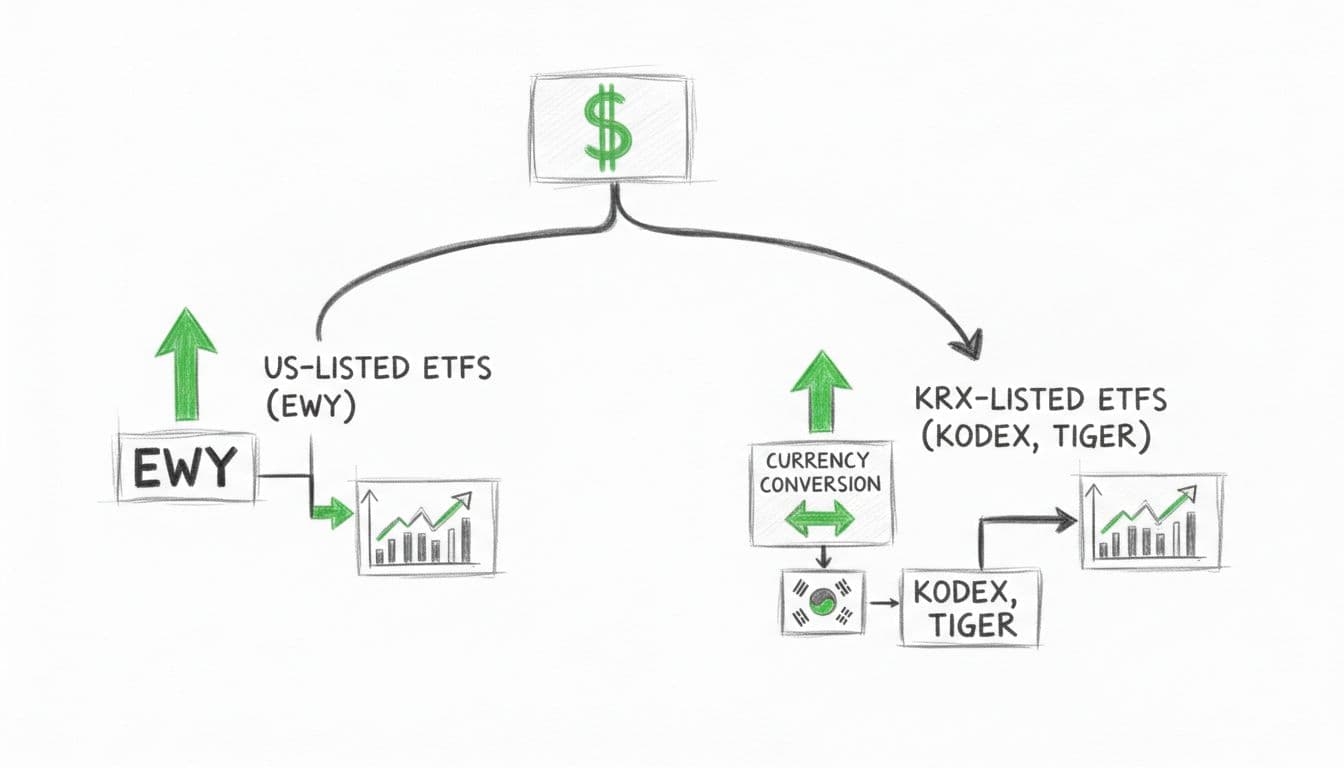
Here's the plain-English trade-off list we should keep in mind:
- Ease: US-listed is simplest, KRX-listed takes setup.
- Selection: KRX-listed usually offers more variety.
- Costs: KRX ETFs can be cheaper on paper, but FX and trading frictions can eat the gap.
- Taxes: US-listed tends to be simpler for US reporting.
- Risk shape: Both routes can still be concentrated in mega-caps.
For index context and how different Korea ETF indices are built, this guide to South Korea ETF indices and options is useful when we're comparing "broad market" versus "sector" exposure.
When US-listed Korea ETFs are the best fit for us
US-listed Korea ETFs behave like normal US stocks. We can buy them at most major brokers, often with $0 commissions. We fund in USD, we trade during US hours, and we don't need a separate KRW cash balance.
Tax reporting is also straightforward. We usually get a 1099, and we handle capital gains and dividends like other US ETFs. For a beginner, this matters because confusion is expensive. If we can't explain our own positions, we're more likely to panic-sell.
The downside is choice and concentration. Many broad Korea products have big exposure to Samsung and SK Hynix through their index weights. So even if the ETF holds dozens of names, it can still move like a "Korean mega-cap tech" bet. If we're hoping for small-cap Korea or factor tilts, the US shelf can feel thin.
When buying Korea-listed ETFs can be worth the extra steps
KRX-listed ETFs can be a better match when we want a specific tool. Korea has many more "precision" ETFs, including dividend strategies, sector-only baskets (like semiconductors or batteries), and theme funds that reflect local investor flows.
Local listing can also mean closer tracking to a Korean index, plus sometimes lower expense ratios. Still, we pay in other ways. We convert USD to KRW, we trade in a different time zone, and we may face wider spreads in smaller ETFs. Liquidity varies a lot, even inside the same theme.
If we go this route, it helps to think like a local. Korea rotates themes fast, and retail flows can amplify moves. That's exciting, but it's also why we need tighter rules.
Step-by-step: how we buy Korean ETFs from a US brokerage account
We'll cover both flows. First, the easy US-listed purchase. Next, the direct KRX workflow (IBKR-style). Along the way, we'll use a research trick that saves time: Global tickers.
Korea-listed tickers are 6 digits, and research sites often show them as:
- KOSPI listings:
XXXXXX.KS - KOSDAQ listings:
XXXXXX.KQ
That suffix is mainly for Yahoo Finance and TradingView. Our broker might not show the suffix, but it helps us confirm we're looking at the right instrument.
Also, quick ETF note: these are ETFs, not single stocks. That means holdings, tracking index rules, and rebalancing matter as much as "the chart."
Buying a US-listed Korea ETF in 10 minutes (EWY as the example)
-
Open a US brokerage account
Any major US broker works. We enable ETF trading (usually default). -
Fund the account in USD
We transfer cash, then wait for it to post as settled buying power. -
Search the ticker: EWY
Before we buy, we check:
- Expense ratio
- Top holdings and sector mix
- Dividend policy (if income matters to us)
A practical habit is to glance at a live quote page to confirm we have the right symbol and typical daily range. For example, this EWY quote and instrument page shows recent pricing and basic stats (we should still verify inside our broker).
-
Choose order type: market vs limit
For ETFs, we often prefer a limit order, especially if the bid-ask spread looks wide. A limit order says, "Buy only at this price or better." It helps avoid surprise fills during a fast move. -
Place a simple example trade
Let's say EWY is trading near $130 and we want 10 shares.
We set a limit order: "Buy 10 shares at $129.80."
If the market dips to our price, we get filled. If it doesn't, the order just waits. -
Set a boring plan
For most of us, the best edge is consistency. We can buy once, or buy monthly, and hold. Korea can run hot, then pull back hard. A plan keeps us from reacting to headlines.
Common beginner mistakes to avoid: buying at the open without a limit, ignoring holdings concentration, and treating a country ETF like a day-trading toy.
Buying a Korea-listed ETF directly on KRX (IBKR-style workflow)
Direct KRX access feels like booking a flight with one connection. It's not hard, but we don't want surprises mid-trip.
- Enable international trading for South Korea
In many global brokers, we request trading permissions for Korea. We may also complete extra disclosures.
If we want a walkthrough-style reference for the IBKR setup vibe, this Interactive Brokers Korea buying guide shows the general flow (menus change, but the sequence is similar).
- Convert USD to KRW
We exchange currency inside the brokerage. Using our example rate ($1 = 1,465 KRW):
$2,000 × 1,465 = 2,930,000 KRW.
The broker may show a slightly different rate because of FX spread and fees.
-
Find the ETF by name and 6-digit code
Example: KODEX 200 (069500.KS) is a widely followed KOSPI 200 tracker.
Even if we trade without the.KSsuffix, that format helps when we research. -
Confirm the correct exchange and currency
We want KRX in KRW, not an ADR, not a different share class, not a look-alike. -
Trade during Korea market hours
KRX regular session is 9:00 AM to 3:30 PM KST.
That's evening in the US, so we plan ahead. If we place orders outside hours, they may queue for the next session depending on broker rules. -
Pick an order type, then place the order
We still prefer limit orders if the spread looks wide. Some Korea-listed ETFs trade actively, others don't. Liquidity matters more than the theme. -
Understand settlement and track in USD
Our KRW ETF can rise in KRW, but we can still lose in USD if KRW weakens.
A simple FX example:
- We buy an ETF at 10,000 KRW, it rises 10 percent to 11,000 KRW.
- Meanwhile, KRW weakens from 1,465 to 1,550 per USD.
When we convert back, the FX hit can shrink our USD gain, or even flip it negative.
For broader context on market access and the differences between KOSPI and KOSDAQ, this explainer on investing in Korean markets helps frame what we're buying underneath the ETF wrapper.
Costs, taxes, and risks we should understand before we buy
Korean ETFs can pay off, but the "silent" drags add up. We should focus on the costs that actually touch our returns, plus the risks that show up when markets get loud.
Before we go deep on funds, we can also check issuer materials and underlying company filings when needed. Korea's official filing system is DART disclosures. We won't use it for every ETF, but it's good for verifying key updates in major holdings.
What we pay (expense ratios, FX, spreads, and hidden frictions)
Expense ratio: US-listed Korea ETFs range from low-cost to mid-range. Korea-listed ETFs can be lower, but not always. The fee is predictable, which is why it's easy to compare.
Bid-ask spread: This is the price gap between buyers and sellers. It's small in very liquid ETFs, and bigger in niche themes. Spreads matter a lot if we trade often. For buy-and-hold investors, they matter less, but they still matter on entry and exit.
FX conversion cost (KRX route): We pay via broker FX fees or spread. If we convert often, this becomes a real drag. If we convert once and hold, it's usually manageable.
International trading fees: Some brokers add market data fees, exchange fees, or higher commissions for foreign markets. We should check the fee schedule before the first trade, not after.
Rule of thumb: costs matter, but behavior matters more. Chasing hot Korea themes after a big run, overtrading, or holding leveraged products too long can overwhelm any fee advantage.
We can also use a simple technical check to avoid buying into a stretched move. Since exact MA values vary by platform and weren't available in public snippets we pulled on March 11, 2026, we should read them directly from our charting tool.
| Instrument | 5-day MA | 20-day MA | 120-day MA (Half-year Life Line) | How we should use it |
|---|---|---|---|---|
| EWY (US-listed) | Check our broker chart | Check our broker chart | Check our broker chart | Price above 120-day often signals a healthier trend |
| KODEX 200 (069500.KS) | Check our broker chart | Check our broker chart | Check our broker chart | If below 120-day, we size smaller and avoid hype buys |
In Korea, many traders call the 120-day moving average the "half-year life line." When price loses that line, sentiment can flip fast.
Investor psychology also shows up in profit-taking. Retail traders often sell near clean, round levels. In the US, that can be $100, $120, $130 on a liquid ETF. In Korea, it can be 10,000 KRW or 50,000 KRW, depending on the ETF's price scale. We don't need to predict it perfectly. We just need to respect that those levels can slow a move.
Investor Alert: Risks to Consider
Investor Alert: Risks to Consider
If we can't explain the risk in one sentence, our position is too big.
- Currency risk (KRW/USD): Direct KRX buying adds FX exposure on top of the ETF move.
- Concentration risk: Broad Korea ETFs often lean on Samsung and SK Hynix weights.
- Sector volatility: Korea can behave like a semiconductor cycle proxy during AI-driven runs.
- Liquidity and time zone: KRX hours can limit quick reactions for US-based investors.
- Leveraged ETF decay (KORU example): Leveraged ETFs can drift lower over time in choppy markets, even if the long-run direction is right.
- Headline risk: Geopolitics and global risk-off shocks can hit Korea fast.
For beginners, we like a simple position-sizing rule: start small, diversify across countries, and avoid leverage until we've lived through a real drawdown.
If our Korea ETF drops hard, we can "hedge" in a basic way by pairing it with something that often rebounds in different conditions. Two common choices are a short-term US Treasury sector (helps in risk-off weeks) or a broad US market sector we already understand (helps avoid overexposure to one country cycle). The goal isn't perfection, it's avoiding a portfolio that sinks for one reason.
Finally, a quick note on governance and overhang. Korean markets still carry "chaebol" governance history, plus occasional overhang from large holders. At the ETF level, this shows up as index concentration and event risk, not single-company blowups, but it still affects volatility.
Conclusion
We can invest in Korean ETFs from the US in two clean ways: buy a US-listed Korea ETF for simplicity, or buy KRX-listed ETFs for more choice and more moving parts. For most of us, the best first step is a broad US-listed fund, then we graduate to KRX only after we're comfortable with KRW, market hours, and spreads.
Our action plan is simple: pick a route, pick one ETF, place a small first trade, track results in USD, then review quarterly. If we stay disciplined about costs and risk, Korea exposure can add real diversification without turning investing into a nightly stress test.
Related: Shift in Korean Wealth: From Real Estate to Stocks (2025 to March 2026), Why We Should Buy Korean Robot Stocks (And How to Do It Without Chasing), AI CHP, AI Semiconductor : Korean Stock Newbies' Guide to the Chips Behind the Boom (March 2026).
Originally published on SeoulStockAlpha.